Mar 25, 2026 | #Stories
Story by the Rev. Kira Austin-Young, photos courtesy of Whitney Gough and the Rev. Kira Austin-Young
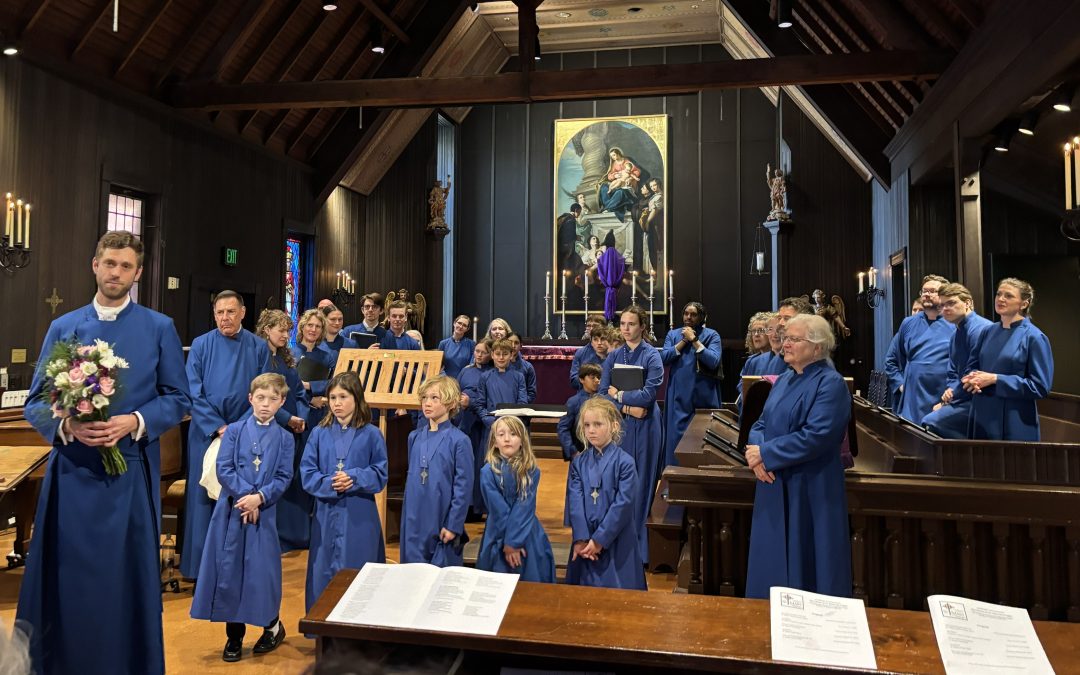
The Church of St. Mary the Virgin in San Francisco gathered this past Sunday in gratitude and celebration to mark a joyful milestone: the 10-year anniversary of Director of Music Eric Choate.
The celebration unfolded over the course of a full Sunday, reflecting the breadth of Choate’s ministry. In the morning, the congregation paused during announcements to give thanks for his decade of leadership, marked by musical excellence, deep care for the choirs, and a profound commitment to the role of music in drawing praise to God.
That afternoon, the celebration continued with a special Candlelight Concert and reception. The program featured works by Bach and Brahms, offered by St. Mary’s children’s, youth, and parish choirs, an embodiment of the vibrant, multigenerational music program Choate has nurtured over the past 10 years. It also featured two compositions based on the text of “Ave Maria,” composed by Choate and Christine Albrecht, a choir member. At the conclusion of the concert, the St. Mary’s Parish Choir presented Choate with a handcrafted wooden music stand. The concert was part of the ongoing Candlelight Concert series and was offered as a gift to the community, highlighting both the beauty of the repertoire and the strength of the musical life Choate has helped build.
The day was not only a recognition of past accomplishments but also a celebration of relationships among choir members, the congregation, and the wider Bay Area musical community, all of whom have been shaped by Choate’s gifts as a conductor, organist, and teacher.
The parish gives thanks for Choate’s decade of ministry and looks ahead with joy to the music yet to come.
Mar 19, 2026 | #Stories, #StrategicVision
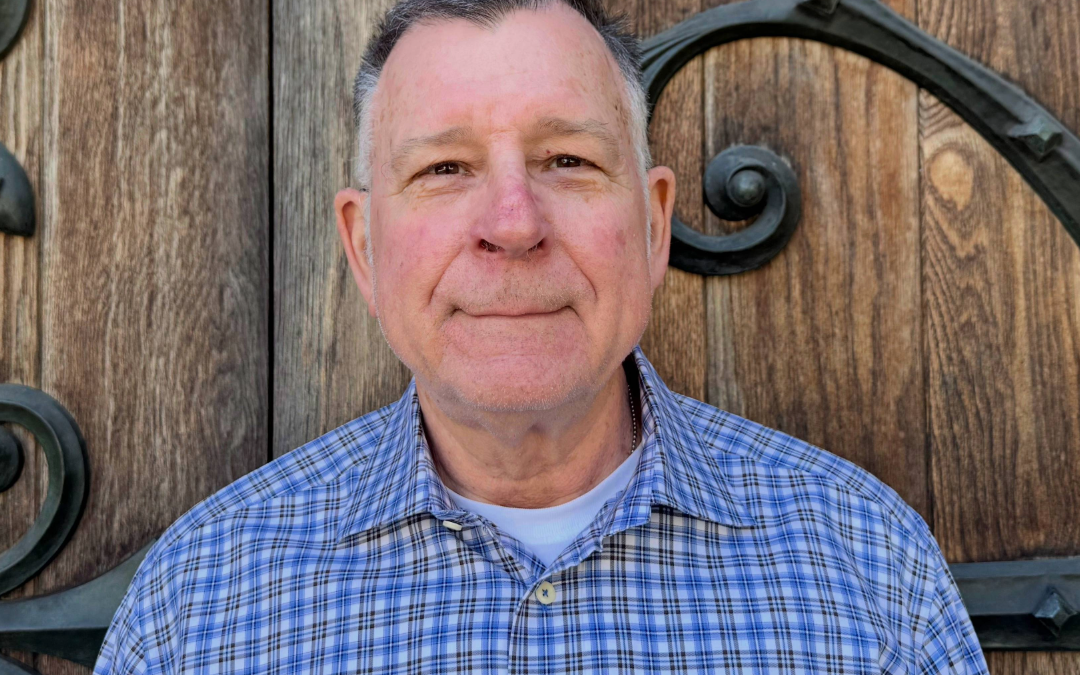
The Diocese of California recently welcomed the Rev. Bob Kossler as Interim Canon for Operations and Finance. In this role, Bob supports the day-to-day functioning of our diocese across a range of areas, including operations, finance, and internal systems.
We spoke with Bob about his role, his background, and how he hopes to support the diocese in the months ahead.
You’ve been here almost three weeks now. What have you been focusing on?
It’s been exciting. There’s a lot going on, not just the financial side, but also things around real estate, IT policy, and HR. HR has been a big focus the last couple of weeks, as I’ve been getting up to speed. So there’s a lot of varied activity.
Can you break down your role a bit, starting with operations?
Finance is more well defined. Operations is probably a little more nebulous.
Typically, in a diocese, operations include things like clergy-related support, property, and buildings. So, if we’re looking at purchasing or selling a building, or working with the appropriate committees on that, that falls under operations. Building repairs and that sort of thing.
It’s a lot of the nuts and bolts of running the diocesan office, as well as helping congregations. HR typically falls under this area, and IT, what tools we use and why we use them.
One of the things I think is important in this role is helping define policies. For example, I’m working on a password policy — really more about explaining best practices for staff and congregations. We’ve had some phishing attempts within the broader church and elsewhere, so helping people understand what to do in those situations is important.
I also think there’s an outreach function. Just like the bishop and canons do visitations, I think it’s important for me to visit congregations as well, so people can put a face to the name.
And how about the finance side of your work?
That includes managing diocesan finances, income statements, balance sheets, working with the Program and Budget Committee, and developing an appropriate budget.
It also includes assessments. We’ll be looking at those and how we do them, along with payroll, benefits, and things like adding or evaluating benefit options.
So, all that falls under this role.
How do you see this role supporting the wider work of the diocese?
The way I look at it is that this role helps carry the operational and financial responsibilities so that the bishop and canon to the ordinary can focus more on mission and formation.
From a strategic standpoint, part of the work is helping think about what needs to be done in the next 30 days, 60 days, 90 days, and over the course of the year. That means making sure that things that are urgent get addressed before they become bigger issues.
You bring experience from both Hewlett-Packard and ordained ministry. How does that shape your approach?
At HP, I started in engineering and worked on systems like ATMs, early electronic stock trading, and mobile communications. Over time, I became more involved in strategy, thinking about what we were building, why we were building it, and what its purpose was.
I also managed teams in the U.S., India, and Germany, and worked with customers around the world. That gave me a better understanding of different cultures and the importance of cultural sensitivity.
At the same time, I was ordained in 2004 and did my internship work as a hospital chaplain at Stanford, while still working at HP. Most of my ministry has been in parish settings, including many years at St. Francis in San Francisco, and more recently as an interim in several congregations.
That combination has helped me understand both the organizational side and the congregational side, what challenges people are facing, and how those can differ depending on context.
Read more: Bob’s background in business and operations
View Bob’s corporate background >>
Before entering this role, Bob spent more than three decades in the technology sector, including leadership roles at Hewlett-Packard Enterprise. His work included global engineering, strategic planning, and financial oversight for large-scale enterprise systems and services.
He led international teams, managed multimillion-dollar budgets, and helped guide long-term technology and business strategy across global markets.
As an interim, how do you think about your role and what you hope to accomplish?
In interim work, the goal is to help put things in place so that the next person can step in and not have to worry about the day-to-day functioning.
That means having processes in place, policies in place, and relationships already built, both within the diocesan office and with congregations and deaneries.
The goal is to leave things in a state where the next person has a smoother transition and can focus on building relationships and looking ahead.
Read more: Bob’s experience in congregations across the diocese
View Bob’s ministry experience >>
In recent years, Bob has served in interim roles at multiple congregations in the Diocese of California, helping guide communities through periods of transition, leadership change, and renewal.
His work has included strengthening operations, supporting stewardship and capital campaigns, overseeing property improvements, and helping congregations prepare for new clergy leadership.
How can people know when to reach out to you?
That’s a really good question, and I think part of the challenge right now is being new in the role. I’m still sorting that out.
If you have specific questions around payroll or benefits, Sarah Crawford is your person. If you have questions about endowment and some of those areas, Shari Gonzales is responsible for that. If you’ve got basic accounting questions, that’s Max Remele.
I sort of see my role as stepping in where something doesn’t fit into one of those buckets. So if you have a question and you’re not sure where it belongs, it’s fair game to give me a call or send me an email and say, “Can you help me?” or “Do you know who might be able to help me?”
For example, someone might be working on a personnel manual or thinking about renting out their building and needing a facilities-use policy. I can help with those kinds of things.
And if I’m not the right person, I’ll help connect you with the person who is.
What’s the best way to reach you?
Phone or email are both fine. My goal is to respond within 24 hours. I think responsiveness is really important.
The Rev. Robert Kossler (he/him)
Interim Canon for Operations and Finance
Episcopal Diocese of California
[email protected]
w. (415) 869-7807
And outside of work, what brings you joy?
My wife and I have two grandchildren who live nearby, and that’s a great joy.
We also have a young dog, and I spend a lot of time hiking with him. I like to fly fish, and in the spring, I go mushroom hunting up in the Sierra foothills.
I’m also part of a couple of book groups, so I enjoy reading and discussing books.
Anything else you’d like people to know?
I’ve also been involved in a number of volunteer roles, serving on the Commission on Ministry, working with Forma in its early days, and currently serving as treasurer on the board of governors at Harvey Mudd College.
That kind of volunteer work has been an important part of my life alongside both my professional and ordained work.
Interview and editing by Stephanie Martin Taylor, Canon for Communications.

Mar 19, 2026 | #Stories
[Cathedral School for Boys] An exhibition at Grace Cathedral is bringing together Bay Area students and internationally recognized artists to explore the histories of immigration, forced migration, and the enduring human search for freedom and belonging. Titled Crossing Borders, the exhibition features artwork by Grade 4 and Grade 8 students from Cathedral School for Boys, alongside works by artists Carl Heyward, Mia Chambers, and Bea Last. The installation invites visitors to reflect on how movement across borders — whether chosen or forced — has shaped human lives and societies.
 Many of the student works draw inspiration from the history of the Angel Island Immigration Station in San Francisco Bay, often called the “Ellis Island of the West.” Nearly one million immigrants passed through the station in the early 20th century, many of them detained for weeks or months while undergoing legal and medical examinations. Through research, interviews, and artistic interpretation, Cathedral School students explored the experiences of immigrants who arrived in California seeking opportunity, refuge, and a new life.
At the center of the exhibition is Carl Heyward’s The Slave Ships, a monumental work confronting the Atlantic slave trade. The installation incorporates a 400-year-old slave ship schematic layered onto a reflective metallic surface, inviting viewers to see themselves reflected in the history it depicts.
Nearby, Mia Chambers’s Cotton Pickin’ Cakewalk features a towering ten-layer sculptural “King Cotton” cake surrounded by smaller cakes representing cotton in various stages of growth. Drawing on the history of the cakewalk — a dance tradition developed by enslaved Africans on plantations — the installation reflects on the domestic slave trade and the cultural resilience that emerged in the face of oppression.
The exhibition also includes The Baby Shoes/Lost Voices, an installation by Scottish sculptor Bea Last composed of worn baby shoes arranged inside a transparent vessel. The work evokes the silenced voices of those lost to genocide and oppression while prompting reflection on the persistence of injustice across generations.
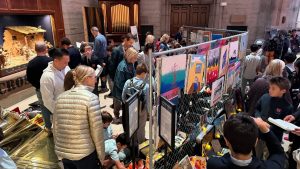 Student work forms a central part of the exhibition. Fourth-grade students contributed pieces from the school’s Journey Project, in which students interview migrants in their own communities, research immigrants who passed through Angel Island, and create multimedia suitcase displays representing those journeys. Eighth-grade students created artworks inspired by poems carved into the wooden walls of the Angel Island detention barracks by immigrants held there in the early 20th century.
For some students, the project connected directly to their own family histories. “The clock in my painting is based on my great-grandfather’s watch,” said Stanley Rzad, a Grade 8 student artist whose work appears in the exhibition. “He immigrated from Poland and worked for Ford for 30 years. I wanted the piece to show the passage of time at Angel Island and the sacrifices immigrants make for future generations.”
During the opening reception on March 13, Grade 4 student Luke Landau reflected on interviewing his mother about her journey immigrating from Vietnam to the United States. “I carry a story on my back that not every kid does,” Landau said.
The exhibition was organized by Will Jaggers, Upper School visual arts teacher at Cathedral School for Boys and a member of The Global Art Project. “When I first saw the Grade 4 Journey Project, I thought the work was so powerful it belonged in a museum,” Jaggers said. “That idea grew into Crossing Borders, bringing our students’ work into conversation with artists from around the world.”
Crossing Borders is open to the public at Grace Cathedral, 1100 California Street in San Francisco, through Thursday, March 26, from 10 a.m. to 5 p.m. daily.
Mar 5, 2026 | #PublicServiceAnnouncement, #Stories, #StrategicVision
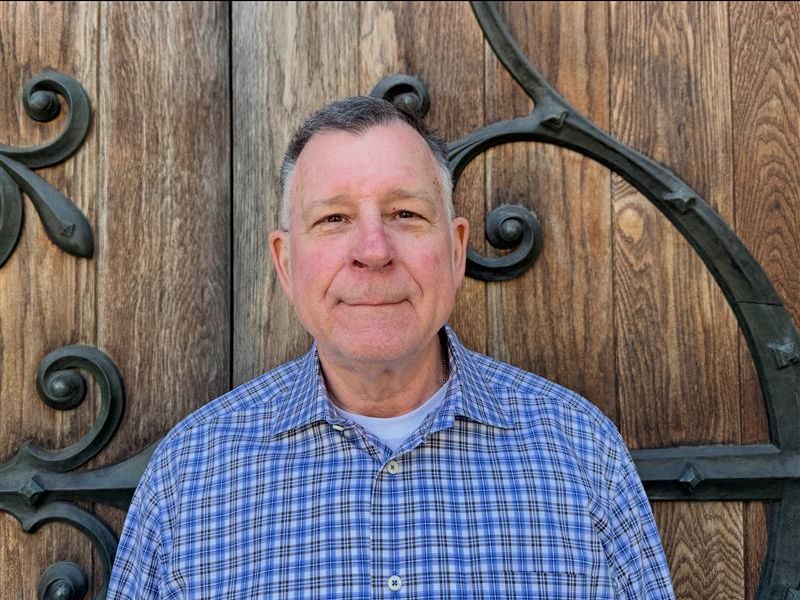
The Episcopal Diocese of California welcomes the Rev. Robert J. Kossler as Interim Canon for Operations and Finance, beginning March 1, 2026. In this role, Bob will serve as Chief Operating Officer, providing strategic leadership for diocesan operations, financial stewardship, and organizational effectiveness.
Bob brings a unique mix of pastoral presence and executive skill to this role. Ordained in 2004 in the Diocese of California, he has served congregations across the Bay Area through times of transition, growth, and renewal—including Church of the Nativity (San Raphael), Holy Innocents (San Francisco), Church of the Epiphany (San Carlos), Transfiguration (San Mateo), and St. Francis (San Francisco). His ministry has been defined by steady leadership during complex changes, successful capital campaigns, improved governance systems, and a collaborative approach that empowers lay leadership.
Before ordination, Bob spent more than thirty years in technology and business leadership, most recently serving as Director of Global Solutions Engineering & Strategy at Hewlett Packard Enterprise, where he managed worldwide operations and strategic planning. He handled multimillion-dollar budgets, led global teams, and spearheaded enterprise transformation that increased revenue from $200 million to over $800 million. His work focused on financial discipline, operational excellence, and strategic innovation—experiences that directly shape his approach to diocesan stewardship and organizational health.
Bob holds a Master of Divinity from the Church Divinity School of the Pacific, an M.S. in Engineering from Stanford University, and a B.S. in Engineering from Harvey Mudd College. He has served on the Diocese’s Commission on Ministry and demonstrates a strong commitment to collaborative governance, transparent financial stewardship, and mission-focused leadership.
As Canon for Operations and Finance, Bob will work closely with Bishop Austin, diocesan staff, and leadership bodies to strengthen operational systems, support the implementation of the Diocese’s strategic vision, and ensure that the Diocese’s resources are aligned with its mission of building the beloved community and embodying God’s reconciling love.
Bob and his spouse live in Oakland.
Please join us in welcoming Bob to his new role!
Mar 5, 2026 | #PublicServiceAnnouncement, #Stories, #StrategicVision
We are excited to share that Laura Eberly will join the diocesan staff as our new Canon for Congregations, starting May 1. To assume this new role, Laura will conclude her dedicated service as the Clergy in Charge at Santiago St. James in Oakland on April 19.
Why This Role Matters
This new position will help our local congregations thrive on a practical level. The Canon’s core purpose is to tend the nets of our common congregational life by centering the gifts and needs of our communities. This means working on the ground with our congregations to assess their health and vitality, while supporting clergy and lay leaders through regular visits, listening tours, and responsive support for their expressed needs. By consulting with vestries and bishop’s committees, Laura will provide concrete tools our communities need to be healthy, faithful, and effective.
A Focus on Our Deaneries
An important part of Laura’s work will happen through our existing deanery structure. Partnering with Canon Sierra Reyes and our Regional Deans, she will work directly with deanery officers to strengthen our capacity to govern and connect our diocese. By empowering our deaneries, we will help foster grassroots collaborations and shared ministries between neighboring churches, ensuring that no congregation has to do ministry in isolation.
Why Laura is the Right Fit
Laura brings an incredibly practical and dynamic skillset to this work. Holding a master’s degree from the University of Chicago’s School of Social Service Administration, Laura has an extensive background in community organizing, training, and change management. She is the founding co-director of Mountaintop Coaching & Consulting, where she guides organizations seeking to align their practices with anti-racist values of diversity, equity, and inclusion via consultation, training, facilitation, project management, and strategic planning. In addition, because she served on our recent Strategic Vision Committee, Laura already understands the needs and hopes of our diocese
Bringing Laura on board as our Canon for Congregations is how we are putting our vision into practice, by giving our local churches the dedicated, hands-on support they need to do the transformative work of the Gospel. Please join us in welcoming Canon Laura Eberly!

Feb 19, 2026 | #Stories
Story and photos by the Rev. Canon Debra Low-Skinner
Originally founded as a mission in 1895 by Nippon Sei Ko Kai (the Anglican Church in Japan), Christ Episcopal Church Sei Ko Kai in San Francisco has served the Japanese American community for over 130 years. Located in its unique Victorian building near Japantown since 1952, Sei Ko Kai members have raised their children, grandchildren, and great-grandchildren here. The congregation also includes members of Chinese and European descent.
Since the pandemic, Sei Ko Kai has held its Sunday services via Zoom — a convenience especially for many members who live outside of San Francisco. They still gather at the church for certain special occasions, however, including the Rev. Canon J. Sierra Reyes’ visit on Sunday, Feb. 1. Reyes, the diocesan canon to the ordinary, was the special guest preacher.
Canon Sierra’s sermon and talk afterwards mentioned how the life cycle of our congregation over 130 years has seen growth, stability, and decline. It has also included time spent literally in the desert, when the church was closed in 1942, and members were rounded up and interned during World War II in inland prison camps located in such desolate places as Topaz, UT, Crystal City, TX, and Rohwer, AR. After the war, when many of our members returned, the church reorganized and reopened in 1948. It experienced resurrection and rapid growth during the Baby Boom years.
The Eucharist celebrant was the congregation’s long-term supply priest and former vicar, the Rev. Canon. Debbie Low-Skinner. She pointed out that Sei Ko Kai was impacted again in the 1960s, when urban renewal led to the demolition of homes and businesses in Japantown and the nearby Fillmore District. Despite this severe disruption, the congregation continued to minister to its members, who commuted in from their new homes in the Richmond, Sunset, and Diamond Heights neighborhoods.
Although the ensuing years saw declining membership, the congregation’s younger members (i.e., Sansei, third-generation Japanese Americans), along with their young children (i.e., Yonsei, fourth- generation), remain committed to keeping this church going. And its financial reserves, along with substantial monthly rental income from its tenants (i.e., Alta Plaza Pre-School and the Integral Counseling Center), ensure that the church can continue its active ministry, with the funded potential to grow in the near future.
After the Feb. 1 Eucharist and meeting with Canon Sierra Reyes, the congregation adjourned to the social hall for fellowship and a bountiful lunch of dim sum, sushi, and fresh fruit.
Additional note: As one of the founding churches of the Japanese American Religious Federation of San Francisco, a few of our parishioners and Canon Debbie Low-Sinner will attend the upcoming Day of Remembrance event at the Japanese Cultural and Community Center of Northern California. This year’s theme is “Neighbors Not Enemies, Stronger Together: Standing Against Mass Detentions and Mass Deportations.” (See the flyer)


