Jul 2, 2026 | #BishopStatements, #Press&BishopStatements, #PressRelease
Lee el mensaje del obispo en español
Dear siblings in Christ,
I have vivid memories of the Fourth of July celebrations of my youth.
Images of red, white, and blue bunting lining houses and city streets in the days leading up to the holiday, infused with the enticing smells of barbecue and cooling homemade pies.
The booming sounds of fireworks blending with the string and horn sections of the Boston Pops and Neil Diamond’s “America.”
As the years stretch further away from those defining moments, I find my reflections on them tinged with the predictable warmth of nostalgia and wistfulness for the simpler time that they represent. I can still connect with my sense of the endless possibility and freedom that this country proclaimed and remember the strength of the community connections and social fabric that helped make those aspirations incarnate. My youngest self not only believed in the American dream, but I felt properly enlisted in the great unbroken line of patriotism that connects tea-dumpers and civil rights icons, veterans and civil servants, revolutionaries and regular citizens.
As a child, I was well indoctrinated in the cult of the flag and an idolization of our country that is so often conflated with patriotism. I said the Pledge of Allegiance at the start of each school day, sang the “Star-Spangled Banner” and “America the Beautiful” with gusto and no hint of irony, and resonated with the pride in America that “My Country, ‘Tis of Thee” and Lee Greenwood’s “God Bless the U.S.A.” portend. My grandmother taught me how to properly unfold and raise the American flag on a flagpole, and how to protect it from undue weather, lower it respectfully, and fold it tightly for safe storage. All of this training instilled a passion for our country and its principles that I carry with me to this day.
And yet, like many, the combination of maturing into adulthood and exposure to the histories and narratives of this country falling outside the officially sanctioned canon revealed the all too frequent disconnect between the vision of what our country could be and what it was in practice. I saw how the pledge’s promise of “liberty and justice for all” seemed to exclude vast swathes of people. I traveled the “land of the free and the home of the brave” and witnessed how freedom and bravery were so often defined according to partisan interests. I marveled at the “amber waves of grain and purple mountains’ majesty” of our geography while lamenting the fraying and tattered fabric of the “brotherhood” that was supposed to stretch “from sea to shining sea.”
Was this dissonance inevitable and just the natural result of moving from the innocence to experience[1] of which William Blake wrote?
Or did my generation experience a unique kind of disillusionment as institutions of decency became corrupted to benefit smaller interest groups, and as our global communications expanded to encompass the world beyond our borders, forcing us to confront the long shadows of our nation-building at home and abroad?
I don’t know if I’ll ever be able to definitively answer that question, but I do know that my sense of allegiance to the superficial symbols of our national identity has diminished in direct proportion to my love of the principles for which they stand. And I cannot separate that change in perspective from my more complete adoption of the narratives of our faith and the proclamation of the Gospel that raises appropriate suspicions about the idol worship that often passes as patriotism. Whether presented in Jesus’ restatement of the Sh’ma[2], in Augustine’s contrast of the city of God and the city of man[3], or in reform movements from the late Middle Ages to the present day, we who follow the way of Christ cannot legitimately give our ultimate allegiance to anyone or anything but the triune God.
Yes, any mature Christian knows that our churches still too often confuse allegiance with God with allegiance to nation, party, or interest group. Yes, the Gospel has much to say to the nation in which it takes root, and our personal politics should rightly flow from the strength of our faith tradition and its deepest truths about what leads to life in abundance[4]. Yes, people of good faith can and do disagree on the details of how to govern and legislate in a way that allows our faith convictions to align with the story of this country and lead to more blessing than curse.
But as we prepare to celebrate the 250th anniversary of this American experiment—a democratic republic ever seeking a more perfect union—it bears repeating that as much as we long for greater transformation in our national life, our efforts of reformation as Christians must commence with the concentric circles of our allegiance.
We begin by focusing on the transformation of self, accomplished through the grace of God and the consistent attention and focus that prayer makes possible. Our primary responsibility as baptized members of the Body of Christ is to allow the Gospel to take root within us and shape us so that the fruits of the Spirit may find greater expression in our daily lives. If Christ has indeed conquered the world,[5] then the conquest starts in our hearts and souls. This is a primary difference between Christ’s reign and all others. Allegiance to Christ’s way cannot be coerced, enforced, or legislated. It arises through the sacrament of baptism and is empowered through grace. And though the battlefield is an interior one, as Christ’s reign grows within, it reveals to us that our diverse, unique, and wonderful selves are not simply isolated entities but part of a larger Body spanning countries, continents, and centuries.
As we experience the first fruits of the Spirit in our lives, we realize that for them to keep growing, we have to labor alongside the other members of the Body in community who are also tending to their own spiritual gardens. Akin to the difference of scale between a home grower of grapes and a vast vineyard, maturing members of the Body see collaboration with others as essential in order to faithfully harvest the fruits of the Spirit and to extend their blessings more widely. This is why we gather for worship, formation, and outreach together and why we zealously spread the good news of this faith that has transformed us with others.
This is a circle of faith that holds so much promise and, sadly, so much heartbreak. As we gather in larger groups, we can sometimes lose sight of the necessary and blessed diversity across difference that constitutes the Body of Christ. At this level, the gaps in understanding, experience, and cultural perspective that exist between us can be exploited by those who serve other idols—like the gods of self and wealth—and finding common ground and the space for disagreement without disconnecting from one another is one of the greatest and most enduring challenges.
But for those who can faithfully attend to the interior transformation and connect this interior journey with the shared life of the Spirit in community without being diverted by lesser calls and interests, the next challenge is to participate in the transformation of the wider world through the love of Christ. This conversion is not about making the entire world Christian in name, as if such a thing would be possible or pleasing to God, but rather about ensuring that that vision of a reconciled world—made incarnate and eternal through Christ’s Passion—becomes more realized in our time.
This is why and how our witness to Christ’s way shows up in the public square, it is why we make common cause with our interfaith and atheist neighbors to make the neighborhoods and countries we share more reflective of the expansive reign of God, and it is why we labor to ensure the personal, the local, and the global dimensions of our faith are aligned. The measure of our effectiveness in this largest circle is not found in our own growth and power as an institution, but in our fidelity to the principles of the Gospel and our integrity of witness binding each of these concentric circles. And for those of us who hold citizenship in this country of the United States, it means holding our country accountable for its stated and lived aspirations, working for a repair of the frayed social fabric across lines of difference and division, and about acknowledging that while our ultimate allegiance is to God alone, our secondary love of country asks us to give our best and most faithful efforts to seeing God’s dream shape our American one, too.
As you prepare to gather with loved ones this holiday weekend, and as we celebrate this milestone anniversary as a country, my prayer is that we can hold together the blessed memories of yesteryear and the aspirations of our forebears while telling the truth about just how far we still have to go as a people. I hope you can truly enjoy the traditions and cuisine that accompany this national holiday while also planting your heart’s deepest desires in the eternal soil of Christ’s reign, free from the innumerable idols that threaten to uproot us and bind us to anything lesser. I hope that you might give thanks for the many blessings of this land and country we share, while remaining steadfastly committed to its reformation.
¡Happy 250th anniversary, USA!
May we never forget to let freedom ring from both the mountainside and the Lincoln Memorial.
May we keep working together for a more perfect union, a more reconciled nation that serves as a channel of blessing more than a conduit of curse, and a country whose most vocally espoused values are more incarnate reality than empty political rhetoric.
May we, as followers of Christ, never lose sight of the fact that our patriotism—as deep and as heartfelt or as wounded and disillusioned as it may be—flows from our allegiance to God alone and can never be yoked to anything lesser.
Yours in Christ,

View footnotes
Un mensaje para el 4 de julio de 2026
Queridos hermanos en Cristo,
Tengo recuerdos vívidos de las celebraciones del 4 de julio de mi juventud.
Estos incluyen imágenes de pequeñas banderas rojas, blancas, y azules bordeando las frentes de casas y las calles de la ciudad, en los días previos a las fiestas, con el aire lleno de los tentadores aromas de barbacoa y de tartas caseras frescas.
Los sonidos estruendosos de los fuegos artificiales se mezclaban con la música de la orquestra Boston Pops y la canción “America” por el cantante Neil Diamond.
A medida que los años se alejan más de esos momentos definitorios, encuentro que mis reflexiones sobre ellos teñidas con la calidez de la memoria y la nostalgia por un tiempo más sencillo que representan.
Todavía puedo conectar con mi sentido de la posibilidad infinita y la libertad que proclamó este país y recordar la fortaleza de las conexiones comunitarias y el tejido social que ayudaron a que esas aspiraciones se materializaran. Mi yo más joven no solo creía en el sueño americano, sino que me sentía realmente encajado en la gran línea inquebrantable de patriotismo que conecta a los que tiraron el té y a iconos de los derechos civiles, veteranos y funcionarios, revolucionarios y ciudadanos comunes.
De niño, estaba bien adoctrinado en el culto a la bandera y en una idolatría de nuestro país que tan a menudo se confunde con el patriotismo. Recité el Juramento a la Bandera al inicio cada mañana en el cole, canté el “Star-Spangled Banner” y “America the Beautiful” con entusiasmo y sin ironía, y resonaba con el orgullo por los Estados Unidos que presagian las canciones “My Country, ‘Tis of Thee” y “God Bless the U.S.A.” de Lee Greenwood. Mi abuela me enseñó a desplegar y levantar correctamente la bandera estadounidense en un mástil, y cómo protegerla del mal tiempo, bajarla respetuosamente y doblarla firmemente para su almacenamiento seguro. Todo este entrenamiento inculcó una pasión por nuestro país y sus principios que llevo conmigo hasta hoy.
Y, sin embargo, yo como muchos experimenté que la combinación de madurar hasta la edad adulta y la exposición a las historias y narrativas de este país fuera del canon oficialmente autorizado reveló la desconexión demasiado frecuente entre la visión de lo que nuestro país podría ser y lo que fue en la práctica. Vi cómo la promesa del juramento de “libertad y justicia para todos” parecía excluir a grandes sectores de personas. Recorrí la “tierra de los libres y el hogar de los valientes” y fui testigo de cómo la libertad y el valor se definían tan a menudo según los intereses partidistas. Me maravillaba de las “olas ámbar de grano y la majestuosidad de las montañas púrpuras” de nuestra geografía mientras lamentaba el tejido deshilachado y desgarrado de la “hermandad” que se suponía debía extenderse “de mar a mar brillante.”
¿Era esta disonancia inevitable y simplemente el resultado natural de pasar de la inocencia a la experiencia[1] sobre la que escribió William Blake?
¿O experimentó mi generación un tipo único de desilusión a medida que las instituciones de decencia se corrompían para beneficiar a grupos de interés más pequeños, y a medida que nuestras comunicaciones globales se expandían para abarcar el mundo más allá de nuestras fronteras, obligándonos a enfrentarnos a las largas sombras de nuestra construcción nacional y externa?
No sé si alguna vez podré responder definitivamente a esa pregunta, pero sí sé que mi sentido de lealtad a los símbolos superficiales de nuestra identidad nacional ha disminuido en proporción directa a mi amor por los principios que representan. Y no puedo separar ese cambio de perspectiva de mi adopción más completa de las narrativas de nuestra fe y la proclamación del Evangelio que despierta sospechas apropiadas sobre la adoración de ídolos que a menudo pasa por patriotismo. Ya sea presentado en la reformulación de la Sh’ma por parte de Jesús[2], en el contraste de Agustín entre la ciudad de Dios y la ciudad del hombre[3], o en los movimientos reformistas desde finales de la Edad Media hasta la actualidad, nosotros que seguimos el camino de Cristo no podemos legítimamente dar nuestra lealtad última a nadie ni a nada que no sea el Dios trino.
Sí, cualquier cristiano maduro sabe que nuestras iglesias todavía confunden con demasiada frecuencia la lealtad con Dios con la lealtad a la nación, partido o grupo de interés. Sí, el Evangelio tiene mucho que decir a la nación en la que echa raíces, y nuestra política personal debería fluir justamente de la fuerza de nuestra tradición de fe y sus verdades más profundas sobre lo que conduce a la vida en [4]abundancia. Sí, las personas de buena fe pueden y no están de acuerdo en los detalles de cómo gobernar y legislar de una manera que permita que nuestras convicciones de fe se alineen con la historia de este país y conduzcan a más bendiciones que maldiciones.
Pero mientras nos preparamos para celebrar el 250º aniversario de este experimento estadounidense—una república democrática que busca siempre una unión más perfecta—conviene repetir que, por mucho que anhelemos una mayor transformación en nuestra vida nacional, nuestros esfuerzos de reforma como cristianos deben comenzar con los círculos concéntricos de nuestra lealtad.
Empezamos centrándonos en la transformación del yo, lograda gracias a la gracia de Dios y a la atención y concentración constantes que la oración hace posible. Nuestra responsabilidad principal como miembros bautizados del Cuerpo de Cristo es permitir que el Evangelio arraigue en nosotros y nos forme para que los frutos del Espíritu encuentren mayor expresión en nuestra vida diaria. Si Cristo realmente ha conquistado el mundo,[5] entonces la conquista comienza en nuestros corazones y almas. Esta es una diferencia fundamental entre el reinado de Cristo y todos los demás. La lealtad al camino de Cristo no puede ser coaccionada, aplicada ni legislada. Surge a través del sacramento del bautismo y se fortalece por la gracia. Y aunque el campo de batalla es interior, a medida que crece el reinado de Cristo en su interior, nos revela que nuestros diversos, únicos y maravillosos yo no son simplemente entidades aisladas, sino parte de un Cuerpo más grande que abarca países, continentes y siglos.
Al experimentar los primeros frutos del Espíritu en nuestras vidas, nos damos cuenta de que para que sigan creciendo, tenemos que trabajar junto a los demás miembros del Cuerpo en comunidad que también cuidan sus propios jardines espirituales. Al igual que la diferencia de escala entre un cultivador casero de uvas y un viñedo vasto, los miembros maduros del Cuerpo consideran esencial la colaboración con otros para cosechar fielmente los frutos del Espíritu y extender sus bendiciones de forma más amplia. Por eso nos reunimos juntos para adorar, formarnos y hacer alcance, y por eso difundimos con celo las buenas nuevas de esta fe que nos ha transformado junto con los demás.
Este es un círculo de fe que tiene tanto potencial y, tristemente, tanto desamor. Al reunirnos en grupos más grandes, a veces podemos perder de vista la diversidad necesaria y bendecida a través de la diferencia que constituye el Cuerpo de Cristo. A este nivel, las lagunas en comprensión, experiencia y perspectiva cultural que existen entre nosotros pueden ser explotadas por quienes sirven a otros ídolos—como los dioses del yo y la riqueza—y encontrar un terreno común y el espacio para el desacuerdo sin desconectarse es uno de los mayores y más duraderos desafíos.
Pero para quienes pueden atender fielmente la transformación interior y conectar este viaje interior con la vida compartida del Espíritu en comunidad sin dejarse distraer por llamados e intereses menores, el siguiente desafío es participar en la transformación del mundo más amplio a través del amor a Cristo. Esta conversión no consiste en hacer que todo el mundo sea cristiano de nombre, como si tal cosa fuera posible o agradable a Dios, sino más bien en asegurar que esa visión de un mundo reconciliado—hecho encarnado y eterno a través de la Pasión de Cristo—se haga más realidad en nuestro tiempo.
Por eso y cómo nuestro testimonio del camino de Cristo se manifesta en la plaza pública, por eso hacemos causa común con nuestros vecinos interreligiosos y ateos para que los barrios y países que compartimos reflejen más el amplio reinado de Dios, y por eso trabajamos para asegurar lo personal, lo local, y las dimensiones globales de nuestra fe están alineadas. La medida de nuestra eficacia en este círculo más grande no se encuentra en nuestro propio crecimiento y poder como institución, sino en nuestra fidelidad a los principios del Evangelio y nuestra integridad de testimonio que une cada uno de estos círculos concéntricos. Y para quienes tenemos la ciudadanía en este país de Estados Unidos, significa exigir a nuestro país responsabilidad por sus aspiraciones declaradas y vividas, trabajar por la reparación del tejido social desgastado a través de líneas de diferencia y división, y reconocer que, aunque nuestra lealtad última es solo a Dios, nuestro amor secundario por la patria nos pide que eremos nuestro mejor y más fiel esfuerzo para que el sueño de Dios moldee nuestro También americano.
Mientras os preparáis para reuniros con vuestros seres queridos este fin de semana festivo, y mientras celebramos este aniversario tan importante como país, mi oración es que podamos mantener unidos los recuerdos benditos de antaño y las aspiraciones de nuestros antepasados, mientras decimos la verdad sobre lo lejos que aún nos queda por recorrer como pueblo. Espero que puedas disfrutar de verdad de las tradiciones y la gastronomía que acompañan a esta festividad nacional, mientras siembras los deseos más profundos de tu corazón en la tierra eterna del reinado de Cristo, libre de los innumerables ídolos que amenazan con arrancarnos y atarnos a cualquier cosa menor. Espero que puedas dar gracias por las muchas bendiciones de esta tierra y país que compartimos, mientras permanezcas firmemente comprometidos con su reforma.
¡Feliz 250 º aniversario, EE!
Que nunca olvidemos dejar que la libertad resuene tanto desde la ladera de la montaña como desde el Monumento a Lincoln.
Que sigamos trabajando juntos por una unión más perfecta, una nación más reconciliada que sirva más como canal de bendición que como conducto de maldición, y un país cuyos valores más defendidos sean más la realidad encarnada que la retórica política vacía.
Que nosotros, como seguidores de Cristo, nunca perdamos de vista el hecho de que nuestro patriotismo —por profundo y sincero o herido y desilusionado que sea— fluye de nuestra lealtad a Dios solo y nunca podrá estar atado a nada menor.
Tuyo en Cristo,
Footnotes
[1]
[2] and
[3]
[4]
[5]

Jan 8, 2026 | #BishopStatements, #Press&BishopStatements, #PressRelease
Read also in Español, Tonga, Tagalog, Chinese
Since Monday, I’ve been participating in a contemplative prayer retreat with some of my fellow bishops in Schuyler, Nebraska. The time we’ve spent has been meaningful, and I am particularly grateful to have begun this new year focused on prayer—this most essential part of our Christian discipleship that can often fall by the wayside as the concerns and crush of the world mount.
Like many of you, I awoke on January 3 to the shocking and disheartening news that our country invaded Venezuela, forcibly removed their president, and unabashedly stated that the U.S. was going to run the country and control its oil production. For an administration that promised many things, including the end of our involvement in “forever wars,” this action is especially alarming. The fact that our duly elected representatives in Congress had absolutely no involvement in this decision is beyond troubling for such a weighty and consequential action.
I asked myself, “What can I do as a Christian, as an American citizen, and as a child of God who values the hard-won democracy that generations of our forebears bled for, marched for, and sought to perfect?”
I am not so naïve as to believe that my salvation arises through our political system or our elected leaders. I do my best to avoid partisan bluster. I endeavor to refrain from the same dehumanization of those who vote differently from me that I find deplorable when aimed at me.
But there are times that require us to make our ultimate allegiance known, and the combination of this action in Venezuela, repeated attempts to rewrite the history of the January 6 Capitol riot, and yesterday’s murder of Renee Good in Minnesota by ICE agents makes me do so now.
As a follower of the One we know as the Prince of Peace, I see war as one of our worst human failures and must only be considered as a last resort. To actively seek it out, especially when one’s own life is not offered in service to the cause, is reckless, foolish, and decidedly not in line with the teachings of Christ.
The attempts to whitewash the violence and insurrection of January 6, on the day we Western Christians celebrate the last day of Christmas and the arrival of the wise ones at Jesus’ manger is jarring. As Christians, we celebrate the Epiphany, which is about the promises of God extending beyond Jesus’ narrow social context and tribe to enlighten the nations and larger world. And yet, January 6 in our country is now known for division, destruction, and deceit. Such misdirection and schemes are more easily associated with King Herod than with the King of Kings who is the way, the truth, and the life.
And when I see another civilian murdered by an ICE agent on a residential street in Minnesota, and the sickening spin that ensues, I wonder when it will be enough. How many more innocent people will die before we decide to say no more? How many of the freedoms our forebears fought for must be erased before we stand up together and take our own risks for freedom’s sake?
As I said earlier, I’ve chosen to begin this new year with a renewed focus on contemplative prayer. The Bishop of Minnesota, the Rt. Rev. Craig Loya, who now must deal with this crisis in his diocese, as well as the Bishop of Washington, the Rt. Rev. Mariann Budde, who called our country to decency and mercy last year during this season, have been praying here as well.
I ask all of you who read this, regardless of who you vote for, to join us in this renewed focus and to attend to your own prayer lives.
Not as a way of shutting out the world, or disengaging from the hard work ahead of us, but as the surest path to discerning how and when to enact your faith allegiance in the public square.
Through contemplative prayer, each of us comes face to face with two simultaneous truths—we are all beset by fears and the shadow sides of our souls that we’d prefer to ignore or hide AND we are all beloved by God in unfathomable ways that we spend this existence exploring. The more we can attune ourselves to these truths, the more we can both receive and extend grace and perceive when it is time to take the fruits of prayer and convert them into action.
As we move into this Epiphany season, in a time of uncertainty and fear in our country, I pray that you will resist the urge to meet violence with violence, hatred with more hatred, and dehumanization with more dehumanization.
Sink the roots of your heart deep into the rich soil of Jesus’ way, truth, and life and draw from the living water that only he can provide. And most importantly, connect with your siblings in Christ for strength and support and keep reminding one another of “whatever is true, whatever is honorable, whatever is just, whatever is pure, whatever is pleasing, whatever is commendable,” and then find ways to live that out together.
For the sake of our country, the sake of our planet, and the sake of your very souls.
Yours in Christ,
Austin
Desde el lunes, he estado participando en un retiro de oración contemplativa con algunos de mis compañeros obispos en Schuyler, Nebraska. El tiempo que hemos dedicado en este retiro ha sido significativo, y he estado especialmente agradecido de comenzar el año nuevo centrándome en la oración—esta parte tan esencial de nuestro discipulado cristiano que a veces puede quedar en segundo plano a medida que aumentan las preocupaciones y presiones del mundo.
Como muchos de ustedes, desperté el 3 de enero con la impactante y desalentadora noticia de que nuestro país invadió Venezuela, destituyó por la fuerza a su presidente y declaró sin complejos que Estados Unidos iba a gobernar el país y controlar su producción de petróleo. Para una administración que prometió muchas cosas, incluso el fin de nuestra participación en “guerras eternas”, esta acción es especialmente alarmante. El hecho de que nuestros representantes debidamente elegidos en el Congreso no tuvieran absolutamente ninguna implicación en esta decisión es más que preocupante para una acción tan importante y trascendental.
Me pregunté: ¿Qué puedo hacer como cristiano, como ciudadano estadounidense y como hijo de Dios que valora la democracia ganada con esfuerzo por la que generaciones de nuestros antepasados sangraron, marcharon y buscaron perfeccionar?
No soy tan ingenuo como para creer que mi salvación surge de nuestro sistema político ni de nuestros líderes electos. Hago todo lo posible por evitar fanfarronería partidista y procuro evitar la misma deshumanización de quienes votan de forma diferente a mí y que encuentro deplorable cuando se dirige a mí.
Pero hay momentos en los que debemos hacer pública nuestra lealtad definitiva, y la combinación de esta acción en Venezuela, los repetidos intentos de reescribir la historia del motín del Capitolio del 6 de enero y el asesinato ayer de La Sra. Renee Good en Minnesota por agentes de ICE me hace hacerlo ahora.
Como seguidor del Único que conocemos como el Príncipe de la Paz, veo la guerra como uno de los peores fracasos humanos que solo debe considerarse como último recurso. Buscarlo activamente, especialmente cuando la propia vida no se ofrece al servicio de la causa, es imprudente, necio y decididamente no concuerda con las enseñanzas de Cristo.
Los intentos de blanquear la violencia y la insurrección del 6 de enero, en el día en que los cristianos occidentales celebramos el último día de Navidad y la llegada de los sabios al pesebre de Jesús, resultan chocantes. Como cristianos, celebramos la Epifanía, que trata sobre las promesas de Dios que se extienden más allá del estrecho contexto social y la tribu de Jesús para iluminar a las naciones y al mundo en general. Y, sin embargo, el 6 de enero en nuestro país es ahora conocido por la división, la destrucción y el engaño. Tales engaños y intrigas se asocian más fácilmente con el rey Herodes que con el Rey de Reyes, que es el camino, la verdad y la vida.
Y cuando vea a otro civil asesinado por un agente de ICE en una calle residencial de Minnesota, y el giro nauseabundo de desinformación que se desataba, me pregunto cuándo será suficiente. ¿Cuántas personas inocentes más morirán antes de que decidamos no decir más? ¿Cuántas de las libertades por las que lucharon nuestros antepasados deben ser borradas antes de que nos levantemos juntos y asumamos nuestros propios riesgos por la libertad?
Como dije antes, he decidido comenzar este nuevo año con un renovado enfoque en la oración contemplativa. El Obispo Craig Loya en Minnesota, que ahora tiene que lidiar con esta crisis en su diócesis, así como La Obispa Mariann Budde, que llamó a nuestro país a la decencia y la misericordia el año pasado durante esta temporada, también han estado orando aquí.
Les pido a todos los que lean esto, independientemente de a quién voten, que les unan a nosotros en este renovado enfoque y que atendáis vuestras propias vidas de oración.
No sea como una forma de aislarse del mundo ni de desvincularse del arduo trabajo que tenemos por delante, sino como el camino más seguro para discernir cómo y cuándo ejercer nuestra lealtad de fe en la plaza pública.
A través de la oración contemplativa, cada uno de nosotros se enfrenta a dos verdades simultáneas: todos estamos acosados por miedos y los lados oscuros de nuestra alma que preferiríamos ignorar o ocultar Y todos somos amados por Dios de formas insondables que dedicamos esta existencia a explorar. Cuanto más sintonizemos con estas verdades en nosotros mismos, más podremos tanto recibir como extender la gracia y percibir cuándo llega el momento de tomar los frutos de la oración y convertirlos en acción.
Al adentrarnos en esta temporada de la Epifanía, en un tiempo de incertidumbre y miedo en nuestro país, rezo para que ustedes resistan el impulso de responder a la violencia con más violencia, al odio con más odio y a la deshumanización para más deshumanización.
Hundan las raíces del corazón profundamente en la rica tierra del camino, la verdad y la vida de Jesús y tomen del agua viva que solo Él puede proporcionar. Y lo más importante, conecten con sus hermanas, hermanos, y hermanes en Cristo para obtener fuerza y apoyo, y recuerden mutuamente “lo que sea verdad, lo que sea honorable, lo justo, lo que sea puro, lo que sea agradable, lo que sea encomiable” — y luego busquen maneras de vivir eso juntos.
Por el bien de nuestro país, por el bien de nuestro planeta y por el bien de sus propias almas.
Suyo en Cristo,
Austin

Jun 10, 2025 | #BishopStatements, #Press&BishopStatements, #PressRelease
Beloved in Christ,
Like all Californians, we are watching with great concern the events unfolding around immigration protests in Los Angeles. We are deeply concerned about the ICE raids and about the potential for violence arising from the deployment of National Guard troops and Marines to the Los Angeles area. We are concerned that military deployments will escalate the confrontations unnecessarily, and worry that all of our regions in California may be subject to future deployments that heighten tensions rather than resolving them.
Bishop John Harvey Taylor, the Episcopal Bishop of Los Angeles, has posted on social media this past weekend about what is happening in Los Angeles and his interpretation of the ways in which local officials, law enforcement, federal agencies, and protesters are all interacting. He expressed deep pain and anger as fourteen people in one single Episcopal congregation in that diocese were detained by ICE on Friday. Certainly, we as Episcopalians are shocked and saddened when any of our own are removed from our beloved community.
In all six of our dioceses, people are concerned and fearful about the denial of due process for those detained and the potential for ICE raids targeting beloved community institutions and people working to support their families. People feel angry and threatened that the haven they sought in our communities is no longer safe. US citizens and legal residents feel deep grief at losing beloved friends and family members. Children whose parents are deported face uncertain futures. In our churches, we strive to protect our members who are at risk.
Our Baptismal Covenant asks us, “Will you strive for justice and peace among all people and respect the dignity of every human being (BCP p. 417)?” This question is a direct and ongoing call to us as persons who follow Christ to live out our calling opposed to injustice, to violence of any kind, and to stand up where human beings are not treated as we would treat a child of God. This question needs to be foremost in our thoughts as we consider our response to the situation in Los Angeles.
In the Episcopal Church, we uphold a proud tradition of advocating for civil rights and supporting the vulnerable in our society. We stand for fierce love and for justice that leads to peace, as well as societal practices that preserve human dignity. With God’s help, we will speak and pray on behalf of all in this situation.
Bishop Taylor has asked for our prayers for Los Angeles, and we invite all our dioceses to pray for the unfolding situation there as well as for peace and justice in all our communities. We ask that you join us in praying:
“Grant, O God, that your holy and life-giving Spirit may so move every human heart, and especially the hearts of the people of this land, that barriers which divide us may crumble, suspicions disappear, and hatreds cease; that our divisions being healed, we may live in justice and peace; through Jesus Christ our Lord. Amen (BCP p. 823).”
In Christ,
The Rt. Rev. Lucinda Ashby
Episcopal Bishop of El Camino Real
The Rt. Rev. David Rice
Episcopal Bishop of San Joaquin
The Rt. Rev. Austin K. Rios
Episcopal Bishop of California
The Rt. Rev. Susan Brown Snook
Episcopal Bishop of San Diego
The Rt. Rev. John Harvey Taylor
Episcopal Bishop of Los Angeles
The Rt. Rev. Megan Traquair
Episcopal Bishop of Northern California
Jun 5, 2025 | #BishopStatements, #Press&BishopStatements, #PressRelease
June 5, 2025
Dear siblings in Christ,
Later today, Presiding Bishop Sean Rowe will release this letter to the wider church concerning the Title IV matter involving Bishop Marc Andrus. Before that happens, I want you to hear directly from me.
The presiding bishop’s statement shares that an accord has been reached with Bishop Andrus following a Title IV investigation and process that was thorough and consultative. Under the terms of this accord, Bishop Andrus remains suspended from ministry while he undergoes a psychological evaluation and continues in spiritual and therapeutic work. The accord also provides for the pastoral care and therapeutic needs of the complainant.
I realize this matter remains painful for many in our diocesan community. If you are carrying any burden from it and would like pastoral support, please reach out to the Rev. Canon J. Sierra Reyes or the Ven. Miguel Bustos. I will continue to be present with our clergy and congregations in the days ahead.
Please join me in praying for healing for all those affected, and for our life together as people rooted in Christ’s mercy and mission.
Yours in Christ,
+Austin
Pastoral care team contact information:
The Rev. J. Sierra Reyes: [email protected]
The Ven. Miguel Bustos: [email protected]
5 de Junio de 2025
Del Obispo Austin: Un Mensaje a Nuestra Diócesis
Queridos hermanos y hermanas en Cristo,
Más tarde en el día de hoy, el obispo primado Sean Rowe enviará esta carta a la Iglesia en general sobre el asunto del Título IV que involucra al Obispo Marc Andrus. Antes de que eso suceda, quiero que se dirijan directamente a mí.
El comunicado del Obispo Primado indica que se ha llegado a un acuerdo con el obispo Andrus tras una investigación y un proceso exhaustivos y consultivos relacionados con el Título IV. Según los términos de ese acuerdo, el obispo Andrus permanece suspendido del ministerio mientras se somete a una evaluación psicológica y persiste con su tarea espiritual y terapéutica. El acuerdo también contempla la atención pastoral y las necesidades terapéuticas del denunciante.
Entiendo que este asunto sigue siendo doloroso para muchos en nuestra comunidad diocesana. Si les preocupa y desean apoyo pastoral, por favor, comuníquense con el Rdo. Cango. J. Sierra Reyes o con el Ven. Miguel Bustos. Seguiré presente con nuestro clero y congregaciones en los próximos días.
Les pido que se unan a mí en oración por la recuperación de todos los afectados y por nuestra vida en comunidad, arraigados en la misericordia y la misión de Cristo.
Suyo en Cristo,
+Austin
Información de contacto del equipo de atención pastoral:
El Rev. J. Sierra Reyes: [email protected]
El Venerable Miguel Bustos: [email protected]

Aug 27, 2024 | #PressRelease, #Stories
With great pleasure, The Rt. Rev. Austin Keith Rios, 9th Bishop of the Diocese of California, announces the appointment of The Rev. Miguel Bustos as Archdeacon of the Diocese of California and Director of the School for Deacons. Archdeacon Bustos will continue to serve as Cathedral Deacon at Grace Cathedral and Manager for Racial Justice and Reconciliation for The Episcopal Church. He will be installed as Archdeacon at Grace Cathedral on Sunday, September 29, at the 11:00 AM Choral Eucharist Service.
Archdeacon Miguel will serve as one of the diocese’s two Archdeacons, along with the Ven. Cn. Nina Pickerrell. Archdeacon Bustos is taking on the position previously held by the Ven. Gary England. In the role of Director of the School for Deacons, he will work closely with the Ven. Hailey McKeefry, who serves as Director of Deacons Formation at Bexley Seabury.
The Archdeacons coordinate the work of the diocese’s deacons, help active and retired deacons stay connected, and serve as chaplains for the Bishop of California.
Archdeacon Bustos was ordained a Deacon in the Diocese of California on December 4, 2021, at Grace Cathedral. Born and raised in San Francisco’s Mission District, he continues to live there with his fiancé, Alexander Rivera, in the house he grew up in.
Aug 13, 2024 | #PressRelease
FOR IMMEDIATE RELEASE
August 13, 2024
Contact:
Stephanie Martin Taylor
Canon for Communications
Episcopal Diocese of California
[email protected]
415-869-7821
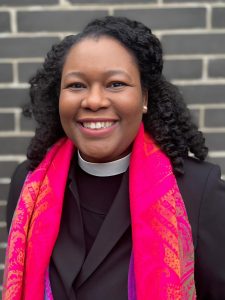
The Rev. Cn. J. Sierra Reyes
At the invitation of the Rt. Rev. Austin Keith Rios, the Rev. J. Sierra Reyes has accepted a new call as Canon to the Ordinary for the Episcopal Diocese of California, beginning September 10, 2024.
“I am grateful to Bishop Austin Rios for inviting me to proclaim the Good News of Christ through word and example as the Canon to the Ordinary in the Diocese of California. I am excited to support our clergy, lay leaders, and congregations in nurturing faith-filled communities that reflect the goodness, courage, and strength of our God. It brings me joy to join Bishop Rios and the Diocese of California in this sacred work,” said Rev. Reyes.
Rev. Reyes most recently served as Canon for Ministry in the Diocese of Chicago, where she managed pastoral transitions and coordinated clergy deployment, search processes, and new clergy support. In her new role as Canon to the Ordinary, Rev. Reyes will serve as the chief of diocesan staff and assist Bishop Rios in supporting clergy, lay leaders, and congregations throughout the Bay Area.
“Sierra comes to us from the Diocese of Chicago, and I could not be more thankful and excited to have her join us in this new chapter of our diocese’s life,” said Bishop Rios. “Besides having served as a rector and a canon on a diocesan staff, Sierra brings her rooted faith and joyful presence to this new appointment as our Canon to the Ordinary. My sincerest hope and prayer is that her skillset and deep love of Jesus and The Episcopal Church will allow her to resource our congregations, institutions, and ministries from her well of experience while serving as Chief of Staff for our DioHouse team. I have the utmost confidence that she will serve among us with grace, curiosity, and joy.”
Rev. Reyes graduated with high honors from Agnes Scott College in Decatur, Georgia, and earned her Master of Divinity from Harvard Divinity School. Her formation for ministry included coursework at Episcopal Divinity School, Cambridge, and a year of study at the University of Cape Town in South Africa.
Following her graduation from Harvard Divinity School, Rev. Reyes served as Associate Rector of Christ Church Episcopal in Savannah, Georgia; Rector of St. Luke’s Episcopal Church in Denver, Colorado; and Interim Associate of Ministries in the Episcopal Diocese of Chicago.
Rev. Reyes is married to Dr. Rudolph Reyes, an Assistant Professor of Christian Ethics and Latinx Studies at Garrett-Evangelical Theological Seminary in Evanston, Illinois. They, along with their daughter, will relocate to the Bay Area in late August.
The Episcopal Diocese of California serves a diverse community of faith encompassing the greater San Francisco Bay Area. With approximately 18,000 baptized members, the diocese consists of 72 active congregations spread across six counties. More information about the Diocese of California can be found at diocal.org