
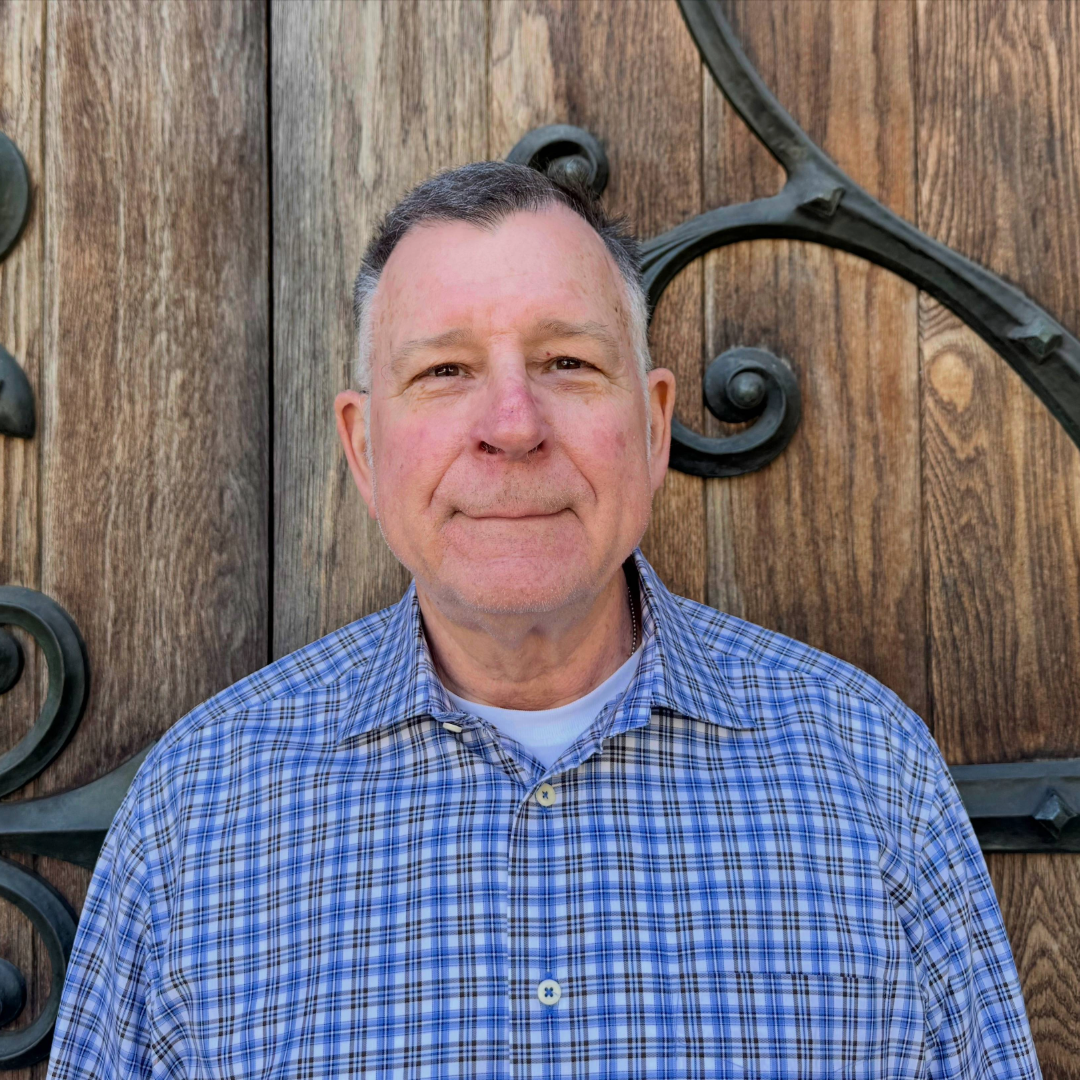
The Diocese of California recently welcomed the Rev. Bob Kossler as Interim Canon for Operations and Finance. In this role, Bob supports the day-to-day functioning of our diocese across a range of areas, including operations, finance, and internal systems.
We spoke with Bob about his role, his background, and how he hopes to support the diocese in the months ahead.
You’ve been here almost three weeks now. What have you been focusing on?
It’s been exciting. There’s a lot going on, not just the financial side, but also things around real estate, IT policy, and HR. HR has been a big focus the last couple of weeks, as I’ve been getting up to speed. So there’s a lot of varied activity.
Can you break down your role a bit, starting with operations?
Finance is more well defined. Operations is probably a little more nebulous.
Typically, in a diocese, operations include things like clergy-related support, property, and buildings. So, if we’re looking at purchasing or selling a building, or working with the appropriate committees on that, that falls under operations. Building repairs and that sort of thing.
It’s a lot of the nuts and bolts of running the diocesan office, as well as helping congregations. HR typically falls under this area, and IT, what tools we use and why we use them.
One of the things I think is important in this role is helping define policies. For example, I’m working on a password policy — really more about explaining best practices for staff and congregations. We’ve had some phishing attempts within the broader church and elsewhere, so helping people understand what to do in those situations is important.
I also think there’s an outreach function. Just like the bishop and canons do visitations, I think it’s important for me to visit congregations as well, so people can put a face to the name.
And how about the finance side of your work?
That includes managing diocesan finances, income statements, balance sheets, working with the Program and Budget Committee, and developing an appropriate budget.
It also includes assessments. We’ll be looking at those and how we do them, along with payroll, benefits, and things like adding or evaluating benefit options.
So, all that falls under this role.
How do you see this role supporting the wider work of the diocese?
The way I look at it is that this role helps carry the operational and financial responsibilities so that the bishop and canon to the ordinary can focus more on mission and formation.
From a strategic standpoint, part of the work is helping think about what needs to be done in the next 30 days, 60 days, 90 days, and over the course of the year. That means making sure that things that are urgent get addressed before they become bigger issues.
You bring experience from both Hewlett-Packard and ordained ministry. How does that shape your approach?
At HP, I started in engineering and worked on systems like ATMs, early electronic stock trading, and mobile communications. Over time, I became more involved in strategy, thinking about what we were building, why we were building it, and what its purpose was.
I also managed teams in the U.S., India, and Germany, and worked with customers around the world. That gave me a better understanding of different cultures and the importance of cultural sensitivity.
At the same time, I was ordained in 2004 and did my internship work as a hospital chaplain at Stanford, while still working at HP. Most of my ministry has been in parish settings, including many years at St. Francis in San Francisco, and more recently as an interim in several congregations.
That combination has helped me understand both the organizational side and the congregational side, what challenges people are facing, and how those can differ depending on context.
Read more: Bob’s background in business and operations
View Bob’s corporate background >>
Before entering this role, Bob spent more than three decades in the technology sector, including leadership roles at Hewlett-Packard Enterprise. His work included global engineering, strategic planning, and financial oversight for large-scale enterprise systems and services.
He led international teams, managed multimillion-dollar budgets, and helped guide long-term technology and business strategy across global markets.
As an interim, how do you think about your role and what you hope to accomplish?
In interim work, the goal is to help put things in place so that the next person can step in and not have to worry about the day-to-day functioning.
That means having processes in place, policies in place, and relationships already built, both within the diocesan office and with congregations and deaneries.
The goal is to leave things in a state where the next person has a smoother transition and can focus on building relationships and looking ahead.
Read more: Bob’s experience in congregations across the diocese
View Bob’s ministry experience >>
In recent years, Bob has served in interim roles at multiple congregations in the Diocese of California, helping guide communities through periods of transition, leadership change, and renewal.
His work has included strengthening operations, supporting stewardship and capital campaigns, overseeing property improvements, and helping congregations prepare for new clergy leadership.
How can people know when to reach out to you?
That’s a really good question, and I think part of the challenge right now is being new in the role. I’m still sorting that out.
If you have specific questions around payroll or benefits, Sarah Crawford is your person. If you have questions about endowment and some of those areas, Shari Gonzales is responsible for that. If you’ve got basic accounting questions, that’s Max Remele.
I sort of see my role as stepping in where something doesn’t fit into one of those buckets. So if you have a question and you’re not sure where it belongs, it’s fair game to give me a call or send me an email and say, “Can you help me?” or “Do you know who might be able to help me?”
For example, someone might be working on a personnel manual or thinking about renting out their building and needing a facilities-use policy. I can help with those kinds of things.
And if I’m not the right person, I’ll help connect you with the person who is.
What’s the best way to reach you?
Phone or email are both fine. My goal is to respond within 24 hours. I think responsiveness is really important.
The Rev. Robert Kossler (he/him)
Interim Canon for Operations and Finance
Episcopal Diocese of California
[email protected]
w. (415) 869-7807
And outside of work, what brings you joy?
My wife and I have two grandchildren who live nearby, and that’s a great joy.
We also have a young dog, and I spend a lot of time hiking with him. I like to fly fish, and in the spring, I go mushroom hunting up in the Sierra foothills.
I’m also part of a couple of book groups, so I enjoy reading and discussing books.
Anything else you’d like people to know?
I’ve also been involved in a number of volunteer roles, serving on the Commission on Ministry, working with Forma in its early days, and currently serving as treasurer on the board of governors at Harvey Mudd College.
That kind of volunteer work has been an important part of my life alongside both my professional and ordained work.
Interview and editing by Stephanie Martin Taylor, Canon for Communications.

