
By the Rev. Canon J. Sierra Reyes, Canon to the Ordinary
I have spent much of my recent time sitting with a specific, holy tension.
Across our Diocese, we are moving through significant shifts. These changes aren’t random but are the result of faithful discernment, deeply aligned with a strategic vision. We are moving toward a future that centers collective empowerment and sufficiency, but I’ve learned that even when a change is “good”, catching up to that vision still carries the weight of grief.
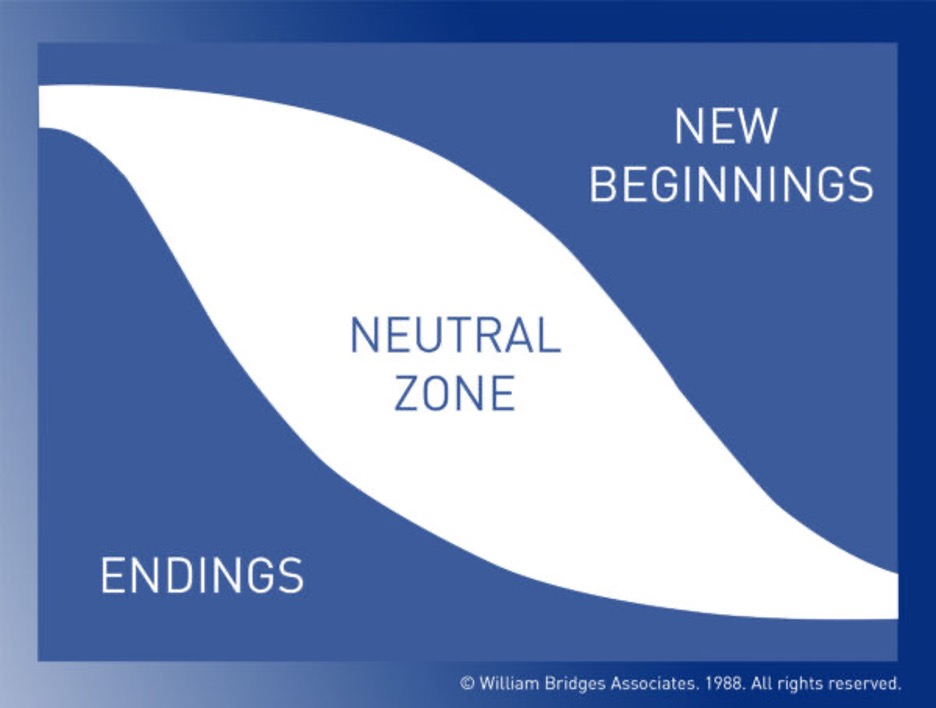
In organizational systems, folks often talk about the difference between change and transition. Change is the external event: a new budget, a restructured staff, or a shift in policy. Transition, however, is the internal, messy, psychological journey we take to catch up to that change.
To help us navigate this, I find myself returning to the William Bridges Transition Model. It reminds us that we don’t just “switch” to the new; we walk through it in three sacred stages.
1. Honoring the Ending
It feels counterintuitive, but every new beginning starts with a loss. Before we can fully inhabit our new vision, we have to acknowledge what we are leaving behind. For some of us, that’s a long-held tradition; for others, it’s a familiar role or way of relating to others.
I think of the Israelites in the book of Exodus. Even as they moved toward the Promised Land, they looked back and mourned the “fleshpots” of Egypt. It wasn’t that they wanted to be back in bondage; it was that the past was known. Giving ourselves permission to grieve the “old way” isn’t a rejection of our future. It is a necessary, honest way of honoring our history.
2. Living in the “Holy Wilderness”
Right now, many of us are in what Bridges calls the Neutral Zone. I prefer to call it our Holy Wilderness. It’s that uncomfortable space where the old ways have faded, but the new rhythms haven’t quite taken root. It can feel chaotic or unsettling.
But the wilderness is exactly where God does God’s best work. Isaiah 43 tells us, “I will make a way in the wilderness and rivers in the desert.” In this “in-between” time, we are invited to lean into one another. We learn that our sufficiency doesn’t come from our structures, but from God’s presence. This is the space where we practice collaboration and learn what it truly means to belong to one another.
3. New Beginnings
Finally, we arrive at the New Beginning. This isn’t just a “start date”. It’s the moment we begin to feel a new energy and see the fruits of our labor. It’s when “mattering” stops being a word in a strategic plan and starts being the felt reality of our shared life.
Please know that Bishop Austin and the diocesan staff are holding these stages with you. Some of us are still in the quiet grief of the Ending, while others are already feeling the spark of the New. Our commitment to you is that we will build Faithful Systems, structures that don’t just move us forward, but hold us tenderly as we go
God is doing a new thing among us in the Diocese of California! My prayer is that we have the patience to walk this wilderness together.

